|
Correction of dual Wagner remontoire phasing - November 2021 This month the last mechanical change takes place on this project. During several videos I noticed that the pair of gravity driven Wagner remontoire carriages tended to drift relative to each other to the point where at times they nearly seemed to be in phase. The entire purpose, or at least to me, is to have them in anti-phase as much as possible to mimic what I’d seen sometime in 2003 on a tower clock by Gillette and Bland in the Royal Courts of Justice, London on my first visit to see the Buchanan firm. The other is to drive the pair of counter-rotating escapement wheels. While the phasing of the remontoire should not have any effect on time keeping, the look of them in anti-phase was important. One might wonder why this drift happens. It is not because there is a 'skip' of a tooth in one or the other escapement wheel. Rather the fact that we are running simultaneously two escapements side by side driven by two independent gravity remontoire. While in theory there should be no slippage between the phasing of the remontoire because the pendulums are slaved together through a pair of metal bands, there will be differences in the time it takes for each remontoire carriage to cycle - they are not nor could they ever be, perfect copies of each other in terms of mass, frictional losses or other kinetic dynamics. This will result in the drift and thus the phasing. Over the long term the cumulative effect is zero and so timekeeping is unaffected, but the look (which is in this project of paramount value) will be affected. After a few conversations I had suggested that perhaps the pair of output arbors from the dual remontoire driving the pair of escapement wheels could be slaved together so as to keep the remontoire carriages in maximum anti-phase.
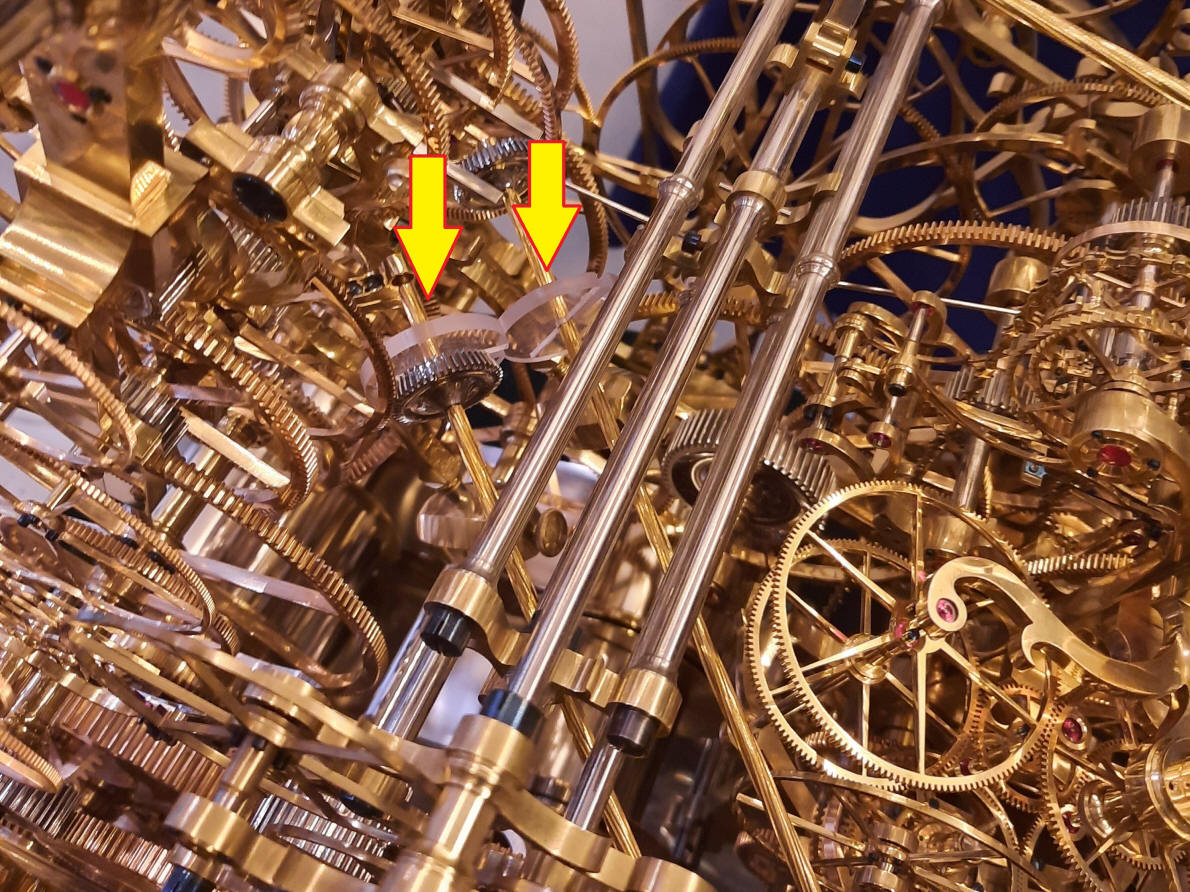
In this photo Buchanan had installed a pair of mockup plastic disks representing what would be a pair of wheels to lock the two output arbors together (yellow arrows). The silver bevel wheel on the left, just in front of the mockup disk is meshing with the remontoire output drive. The right arbor's drive bevel is located a bit further behind that plastic mockup wheel. One can see the area in which the mockup wheels are located to be pretty tight. This is not surprising given the complexity of the machine, but is especially so since this is a retro-fit where we try to insert additional components in an area where space for such components wes never provided for.
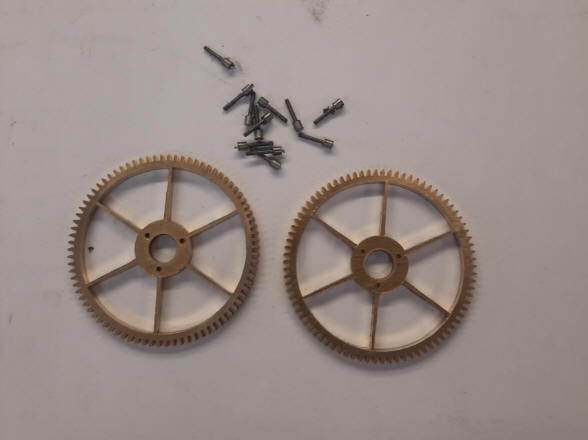
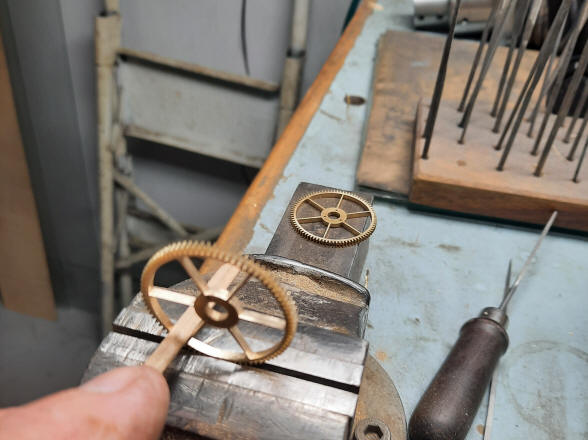
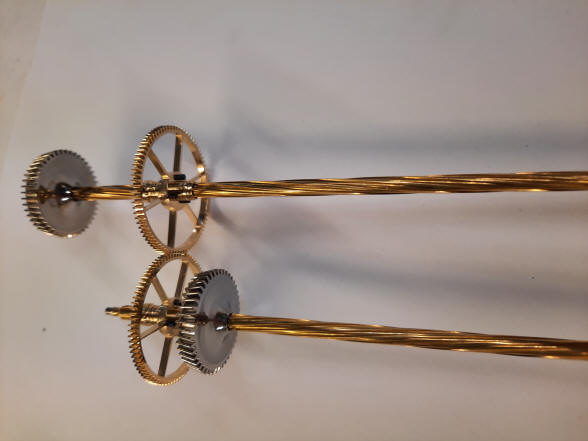
The synchronizing wheels are cut, next the finishing work begins with the smoothing of the inner spokes.
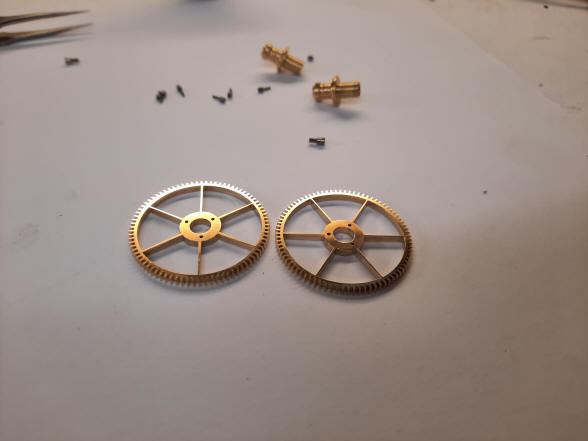
The synchronizing wheels are now finished and in the second photo they are assembled with their polished collets and blued screws onto the twisted 'barber pole' arbors.
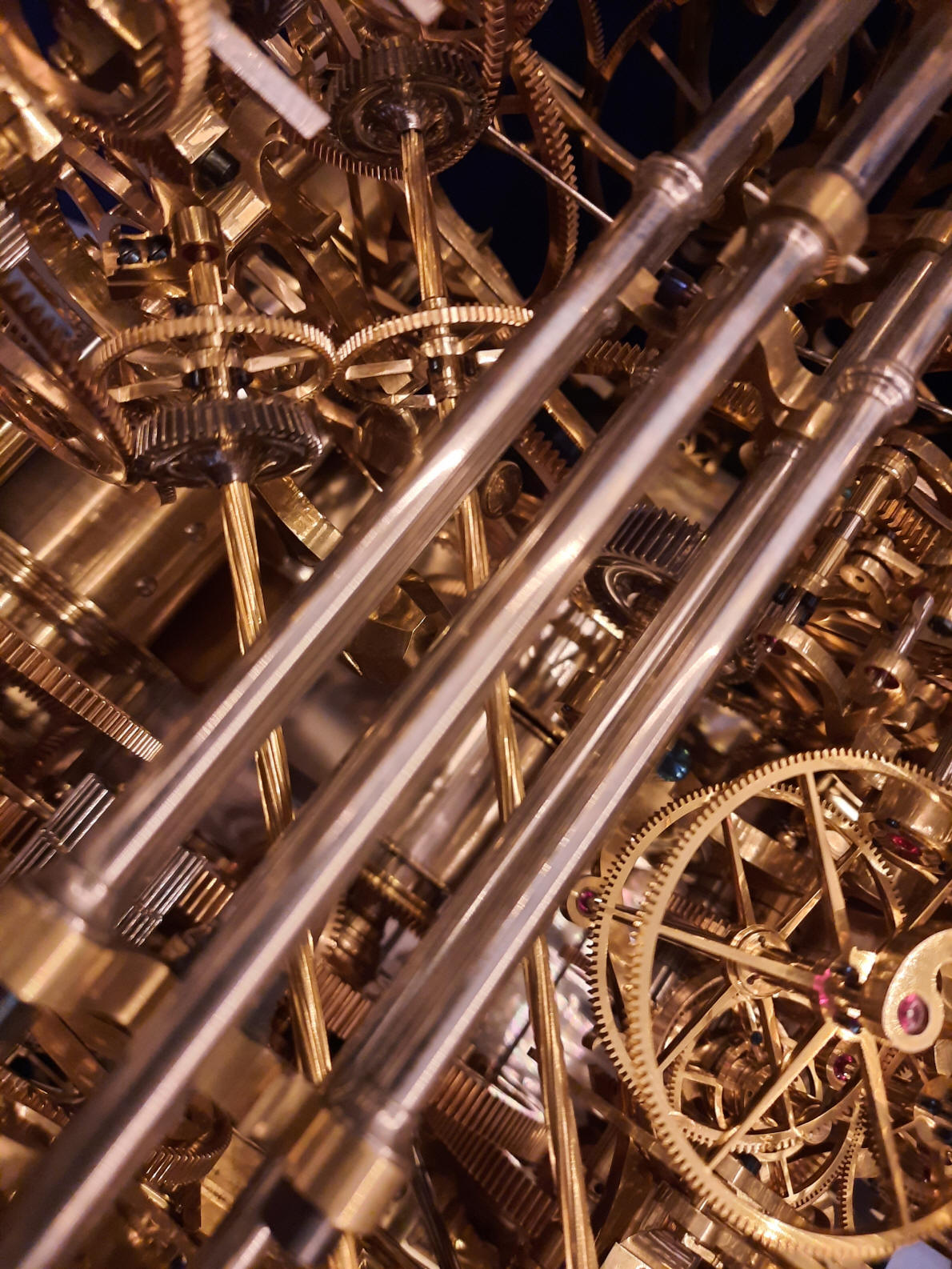
The wheels had to be re-cut twice to get the proper fit within the tight space. Once they were rechecked they were installed and tested. Afterward Buchanan wrote that they were a success. Not only did they keep the carriages in correct phasing but seemed to limit the 'bounce' that always plagued these structures as they cycled at the end of their maximum travel upwards. This is due in part to the the mass of the large carriages and that the time train runs on a two-second cycle set of pendulums which also exacerbates the bounce because the cycle is slow to reset due to the doubling of the time cycle. Some of this was eliminated with spring-loaded cam stops, but this new device seems to further cut it in half. Perhaps this is because some of the energy associated with the recycle of one carriage is absorbed into the other during its normal travel At any rate this was a very welcome bonus. Of course nothing is free, and the down side is that since the two escapements are no longer totally independent, if one escape wheel should become unsynchronized from the other there is a procedure one must do to rebalance the remontoire so both are operating in harmony. Basically one must stop one or the other escape wheel while the other is running for one or two 'ticks'. With practice it becomes easy to eyeball the escapement pallets to see when everything is correct. This was the last mechanical change in the project. Only the creation of the dedication plate and operators key set remains.
This video shows the pair of wheels that slave together the output power from the pair of Wagner gravity remontoire which, in turn, power the dual Harrison grasshopper escapement wheels. This corrects for the 'phase drift' between the remontoire carriages so they will stay in anti-phase instead of drifting between in-phase to anti-phase. |