Fabrication of dial work, compilation of work 2008 through January 2012 - June 2013, part 1
There are only five components in this project which have been outsourced. The first are the pivot bearings. There are two types used in this project the first are jewels which are used in those areas where the arbors will turn slowly (less than once per hour) and are lightly loaded. Because of these factors we will be using them without lubricants. Buchanan ordered several hundred synthetic ruby jewels from Switzerland. The other type of bearing are ceramic roller bearings used in all other pivot points where the rotational period is greater than once per hour and or the there is greater than a light load. A compelling feature of these is the fact that they too can be used without the need for lubricants. The second outsourced component are the strike train bells. These were ordered from the Whitechapel Bell Foundry, London.
The third are the four pendulum balance springs, these are made of a special
material, The fourth are the motor springs substituted for the original weight driven design in November of 2019. ¹The fifth outsourced component is the enamel dials. This project will use twenty one dials to illustrate the various complications both for time and the celestial functions. (There will also be a number of smaller engraved silver dials throughout the machine for various adjustment indicators) During the initial development of this project during 2004 -2006 we had planned for engraved silver dials. However, by mid 2006 I began to formulate the idea of substituting the silvered dials for real, fired enamel dials. It began as I contemplated how an engraved plate would look for the planisphere and began to think that something in color, in enamel might be better. This change would add a classical element to the design. Most clocks that are hand made include engraved dials. A competent clockmaker can, with the right equipment, make very presentable engraved dials. Particularly if they do not involve freehand script. Enamel dials, on the other hand, requires a skill set and equipment that is not normally a part of the clockmakers expertise. For this reason, throughout horological history, whenever a clock was made that had fired enamel dials this job was outsourced to a dial making firm. At the time I made this decision, I had no idea who did such work, with the exception of the firm of Donzé Cadrans in Switzerland. They had completed a set of lovely dials for a prior project Buchanan had completed on a dual pendulum regulator. There were some other dial houses here in the United States, but they were generally dial repair firms, or reproducing damaged dials, but not creating unique, one off dials to design. We approached Donzé 2007 and found them impossible to work with. They seemed uninterested in responding to our requests. It was quite frustrating. It later turns out that they were in the midst of an internal reshuffle and in 2011 the owners had sold the firm to the watchmaker firm Ulysse Nardin so they were no longer available for outside work. I had seen advertisements for replica skeleton clocks by the firm of ProClocks and many of their clocks had enamel dials. Their firm also had examples of their clocks at the National Association of Watch and Clock Collectors (NAWCC) clock fairs. They also promoted their dial making, repair and replication services. Bob Crowder, the proprietor, expressed an interest in being a part of this project and I thought this could be a good fit. Bob was accessible, not to mention spoke English! He had a facility in China that produced fired enamel dials and he was enthusiastic to make his firm a part of this project. I liked the fact that the dials would be hand painted and fired and China is a country steeped in this tradition. I decided to give ProClocks as a first trial what I thought to be the most difficult dial to make. This was the dial for the planisphere which has a depiction of the stars at the latitude of Chicago, along with their names, the signs of the zodiac and constellations. There are literally hundreds of separate diagrammatic components to this dial.
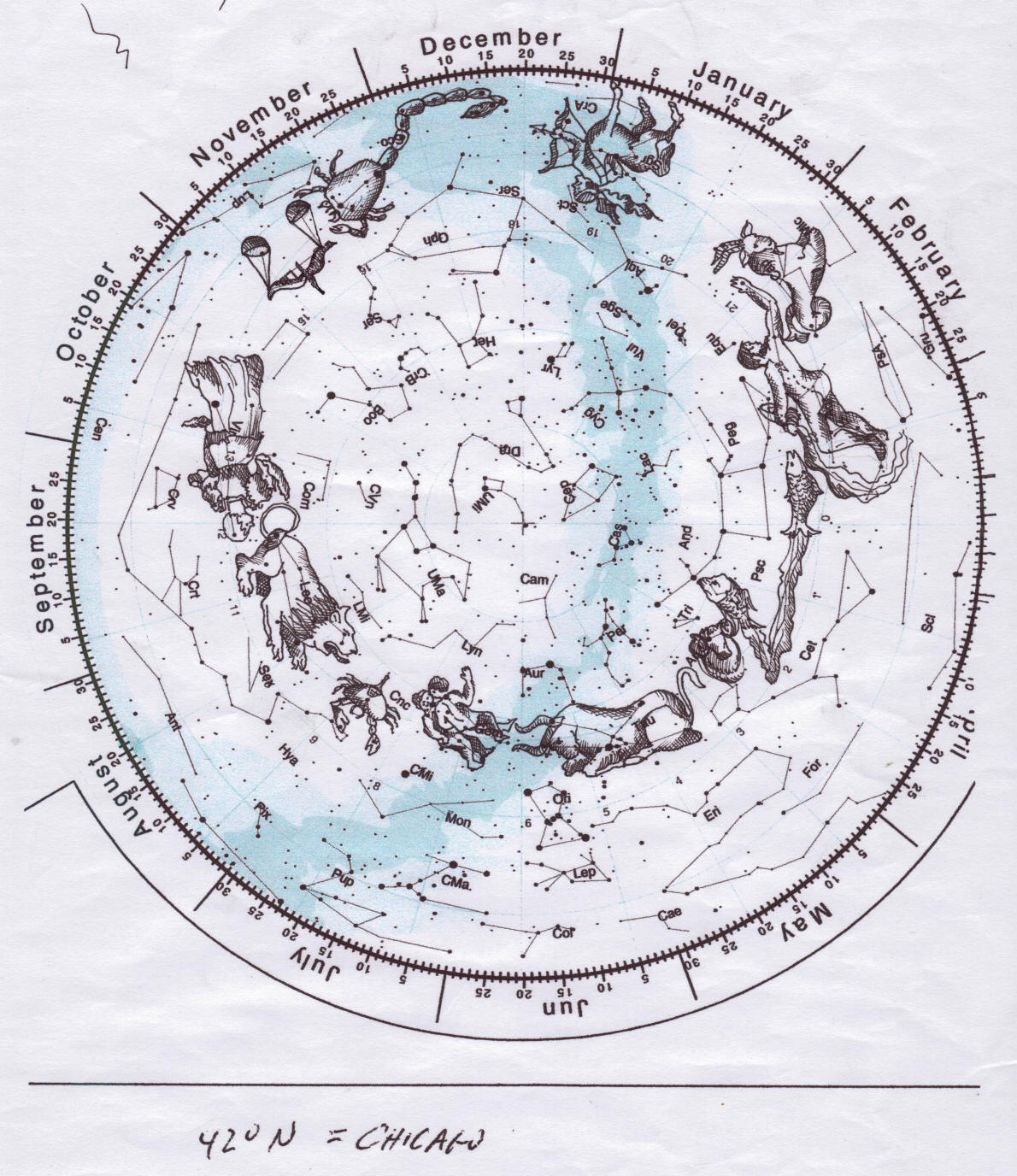
I started out with a planisphere that I had downloaded from a website on the internet in late 2007. There are many sites that allow one to 'build you own' star gazing planisphere adjusted to your exact latitude. Chicago is 41.8819 degrees. This download served as the basis for our design.
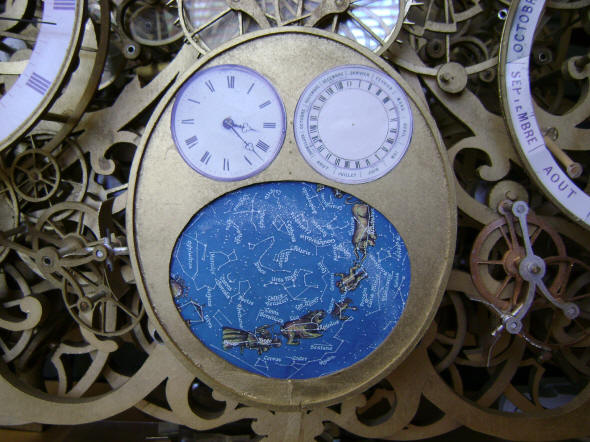
These two photos from February 2008 are an early design concept for the planisphere as it would look like within the context of that subassembly and the overall movement. Note that the clock looks very different from its current incarnation. This design had the entire movement within two large fretted frames following a conventional plate and spacer concept. That was abandoned in early 2009 as impractical in exchange for the current pillar design. In this early mockup the planisphere also contains the sidereal and celestial demonstration functions. This would also later be revised. It looks too much like the main character's face in the famous Norwegian painter's work, Edvard Munch, The Scream.
In September of 2011 I received the hand painted artwork from Buchanan. It was over-sized at eleven inches across. The actual dial is about five inches.
This picture is my changes made on the computer to color-adjust and accentuate the gradual blue shading toward the edge of the dial.
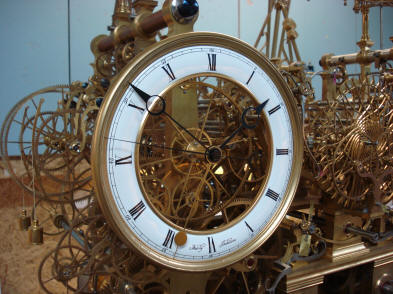
Next the artwork for the mean solar time dial (main time dial) is created and displayed in a wood mockup bezel on the clock movement. This was later redesigned to substitute the "Made by Buchanan' to simply 'Buchanan Chelmsford'.
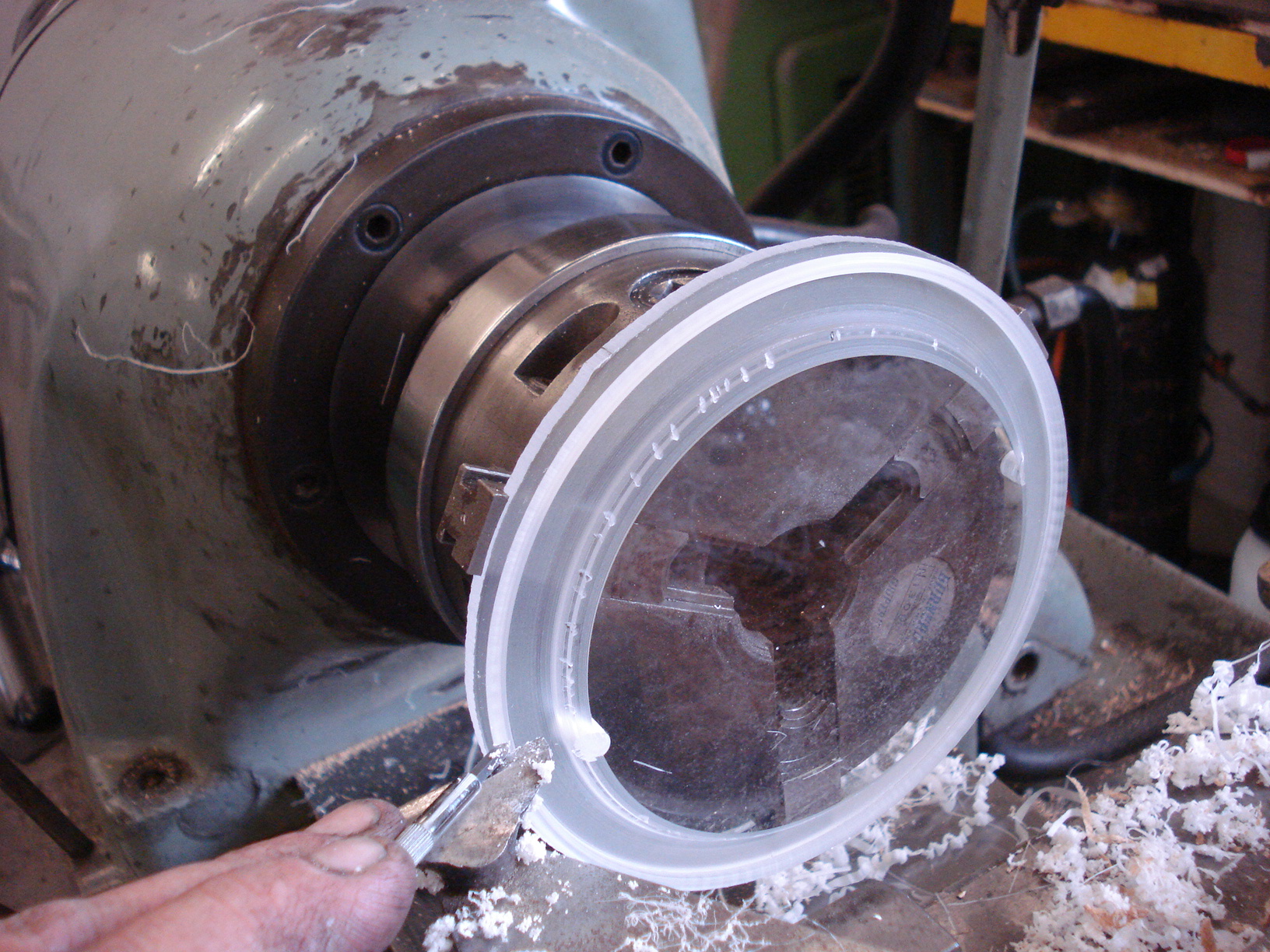
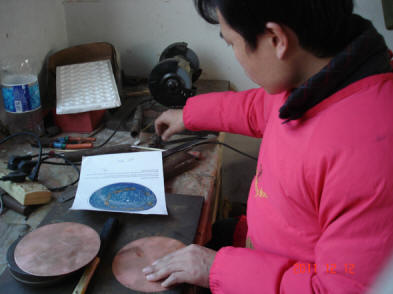
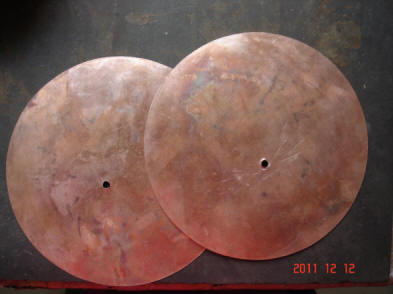
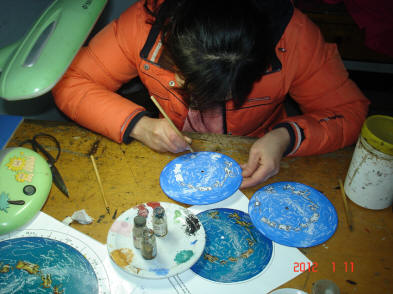
All of the the dials that are in the form of a ring will have a slight curvature to the surface. Buchanan makes an replica ring with the proper curvature from plastic and then glues the artwork to that ring so the dial makers have an exact one-to-one master to copy from. The next pictures show the fabrication of the planisphere dial in China. This dial was a flat disc. The expert enameling is carried out by Mr. and Mrs. Feng. First Mrs. Feng prepares the copper substrate. All of the dial work has a copper substrate and this is the same way dials have been made for centuries.
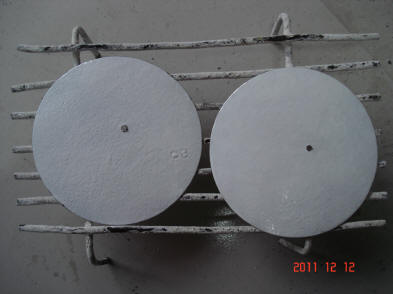
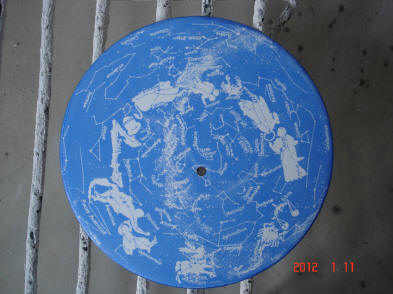
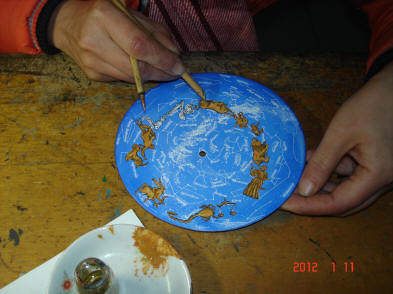
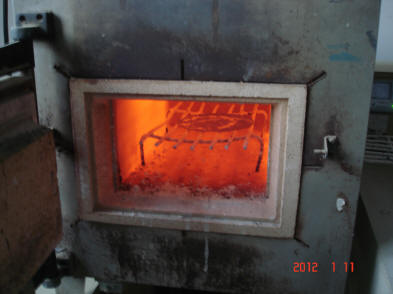
It was decided to make a pair of these dials simultaneously in case there was a problem in the fabrication process with one of them. Things can go wrong, especially in the kiln after repeated firings for each color so the decision was made to make a pair just in case one was ruined. Cracking bubbling or warping of the dial can occur. Sometimes colors simply come out of the kiln in unexpected ways. The third photo shows one of the enamellers, Mr. Gao Feng painting in the figural outlines, lettering and star fields all on a copper blank. The dial has already been fired once in a kiln to produce blue background. He accurately picked up all the detail in Buchanan’s original artwork, from over a thousand various sized star dots for the Milky Way, right down to the calligraphic lettering and the correct star constellation representing each figure of the zodiac and then it is again fired.
Next the detailing is painted on, as mentioned above the enamels are a husband wife team, Mr. and Mrs. Feng. He does the lettering and she does the figures. Note that the lettering we supplied in the artwork was anything but plain. It has a calligraphic style; very difficult to make especially at such a small scale. After the white outlining is done it goes into the kiln, one can just see the zodiac figures glowing, (second photo below).
Here we see the artwork near completion.
Mrs. Feng adds the black
accenting, then another firing, and then the brown figural coloring. A
fourth, green color is added last and then the final firing. Of course
things can go wrong, especially in the kiln after repeated firings -
cracking, bubbling or warping of the dial can occur. Sometimes colors simply
come out of the kiln in unexpected ways, so the decision was made to make a
pair just in case one was ruined.
The dials were sent to Buchanan in January 2012 were installed into a wood mockup bezel and mounted onto the clock. Notice the correct curvature of the dial. This is due to the curvature of the copper blank upon which the enameling is applied. One of the completed planisphere dials is shown below.  Original planisphere dial completed on January 12, 2012 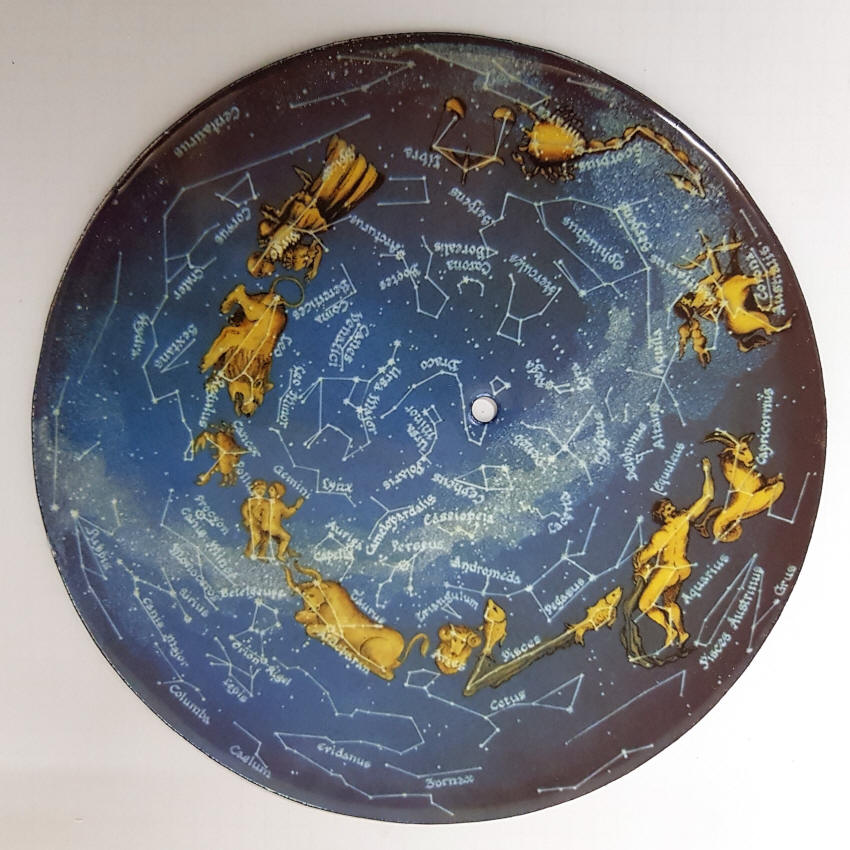 The dial above was a remake in July of 2020 after an accident in installation of the original dial occurred earlier that year. The new dial is a superior remake and more closely matches the original artwork, especially in the blue background where the center blue shades into a darker hue as one moves towards the perimeter and better than I’d hoped. We had found the right supplier for the project. Bob was an enthusiastic partner throughout the process and made a significant contribution to it. There were only three components that were outsourced for the clock: jewel and ceramic bearings, bells and the enamel dialing, and while all of these components are essential, by far the dials required the most creativity and guidance from the supplier, and from a visual perspective have the greatest impact. I had considered engraved dials as Buchanan’s engraving skills are excellent, but enamel, especially with color gives a special touch. Most scratch-built clocks have engraved dials since enamel dialing is a rare specialty skill that must be sub-contracted.
|









1. This major additional major component not made by Buchanan was incorporated into the project in July 2019. At this time we changed the power source from weights to motor springs and was added to this website six and one-half years later.