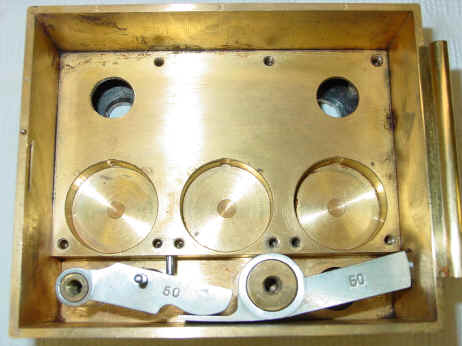
| When this lock was acquired, the case and bolts were in a dirty,
deteriorated condition. The movements were completely unserviceable. In addition these
were of a later date (1950-1960) than the case, that being c. 1900-1920. All of the screws
and bolts were corroded the rest of the lock needing a complete cleaning. To get the bolts
back to their original blued condition, they had to be re-surfaced to remove the
corrosion, polished and then heated to regain their original blued steel color.
A heat gun makes for a good, controlled heat source for small, compact parts like screws. Once the part is brought up to temperature, the right color is achieved. This happens in a very brief period of time - a second or two. The part is then quickly quenched in water to hold the color. Later I smear some light oil over the part to prevent corrosion.
Here a comparison between a bolt as found complete with corrosion and chewed up slot from the sloppy use of a mis-sized screw driver. The bolt must be resurfaced to remove corrosion, the slot dressed and then polished to prepare the surface before heat treatment to get the blue color.
Time locks are precision instruments. They had to be both accurate and reliable. Failure meant that the safe could not be opened and much expense, time and embarrassment would ensue. These last two photos shows the typical way that these locks were manufactured. Most if not all parts were serial numbered and assembled as an individual entity. mass production, while wide spread at the time, was not used in this industry until much later in the the 20th century.
|