|
Yale & Towne Manufacturing Co., Stamford, Connecticut - 2 movements, Type G In 1887, Yale patented a time lock design that would mark a new direction for Yale and, eventually, the entire time lock industry: its Type B and Type C time locks, which went into production in 1888. Based on pocket watch movements rather than on the larger clock movements of the Pin Dials, these smaller-format movements were inherently suited to be individually replaceable or "modular" movements. These were also the smallest format three movement time locks made to that time. Yale would not have a smaller three movement design for bolt dog release until the model T321 introduced about 1900 and would never surpass the compact Yale C and E designs for the automatic release function. No other time lock manufacturer made a smaller three movement lock. With the introduction of the Type D, Type E and Type G time locks, Yale debuted their own line of automatic bolt motors. These automatics were soon popular with banks and businesses with regular hours, used in the new "solid door" safes, a safe with no key hole or combination lock spindle, handle or any other connection to the outside, that relied solely on the high-quality time lock and automatic bolt motor. (1)
The line of Yale Type B through E and EE time locks pictured, upper row from left to right. The lower row shows A and G. Only the Type B through EE series went into production. The A was a unique patent prototype piece and was never slated for production. The G was only made as salesman's samples. At the present time only one Type C, two EE and two complete G has been found. Yale did make one or two BB, and three DD locks, none of which are known to survive. There were no records of a CC being made. These facts makes this collection unique in that it contains the most complete set of all the examples extant. No records for or examples of a Type F are known.
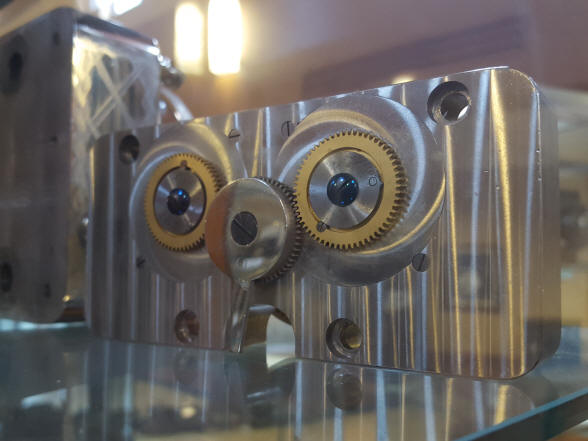
The movements used in Yale's B-EE models were American Waltham Watch Co, size 14, Model 84, Hillside grade. The spring and its barrel are removed and replaced with a wheel and longer arbor that passes through the rear plate and having a pinion mounted to that portion past the plate; held by an added cock, see second photo above. Meshing with that pinion is a large spring barrel increasing the standard twenty four hour duration of the movement to the requisite seventy two hours needed in a time lock. Yale's Type G time lock was introduced concurrently with the D and E, in 1888. (There is no record of a Yale Type F.) The Type G, which used two seventy-two hour modular Waltham made pocket watch movements, was Yale's smallest time lock to date. Its dial attributes a patent to Stockwell, but no Type G-specific patent has been identified. Like the Types D and E, the two Type G movements each have an up/down power reserve indicator and are wound simultaneously by the single central key-driven arbor, the same design as used in the Type D and E. Interestingly, American Waltham Watch Co, had specific names for each damascening pattern that they used on movements; the pattern used on the movements for the Types B through G was designated "Hillside". Yale's Type E offered the option of a key and combination-free door too, but it was large, requiring even more space than earlier models. For smaller safes, Yale introduced the Type G with with the same benefits of the Type E, but in a more compact format albeit with two rather than three movements. As with the Types D and E, production of the Type G ended in 1891 and was probably considered unsuccessful: only twenty two Type Gs seem to have been made, with two consigned, but none known to be sold. ¹
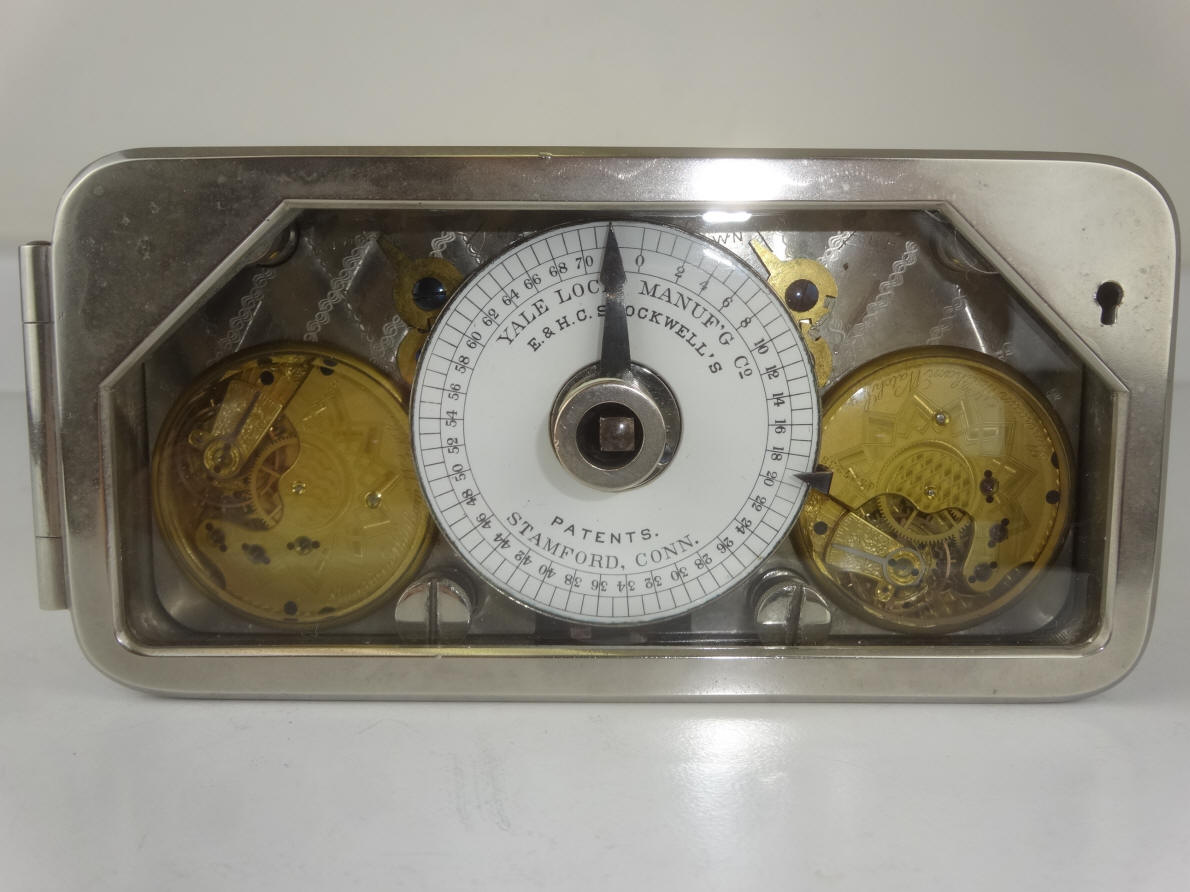
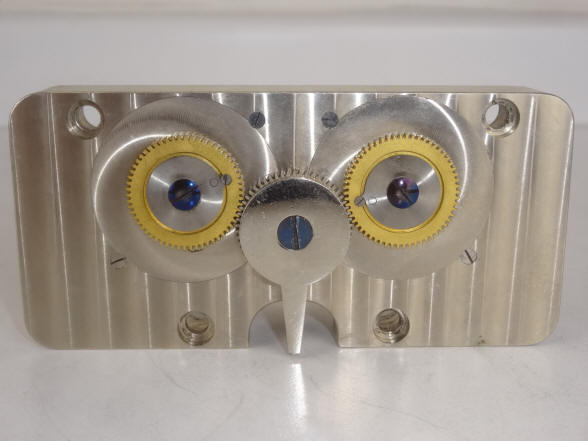
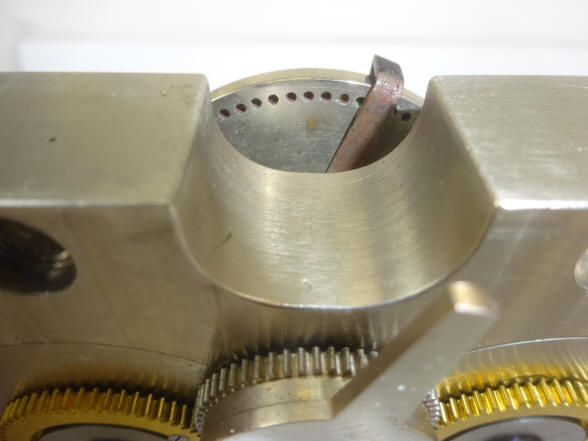
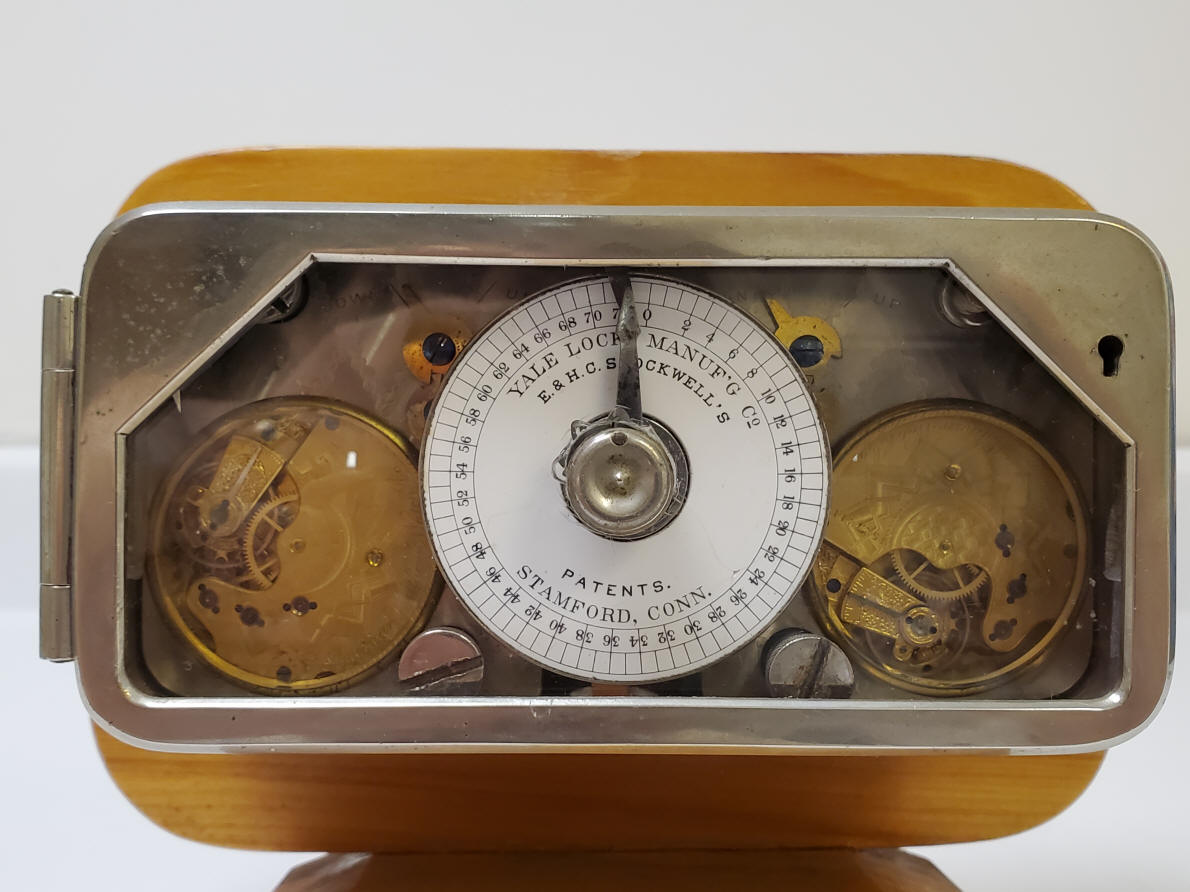
Front elevation of the Type G. Note the position of the stop flag at the 3:30 position on the dial rim which had to be positioned so as to always be ahead of the pointer to perform its function. The flag is currently at 19 hours and so the operator could simply set the dial to that position without worrying about overwinding. The flag could be set for any hour via a set of seventy-two holes on the rear of the dial, see photo below.
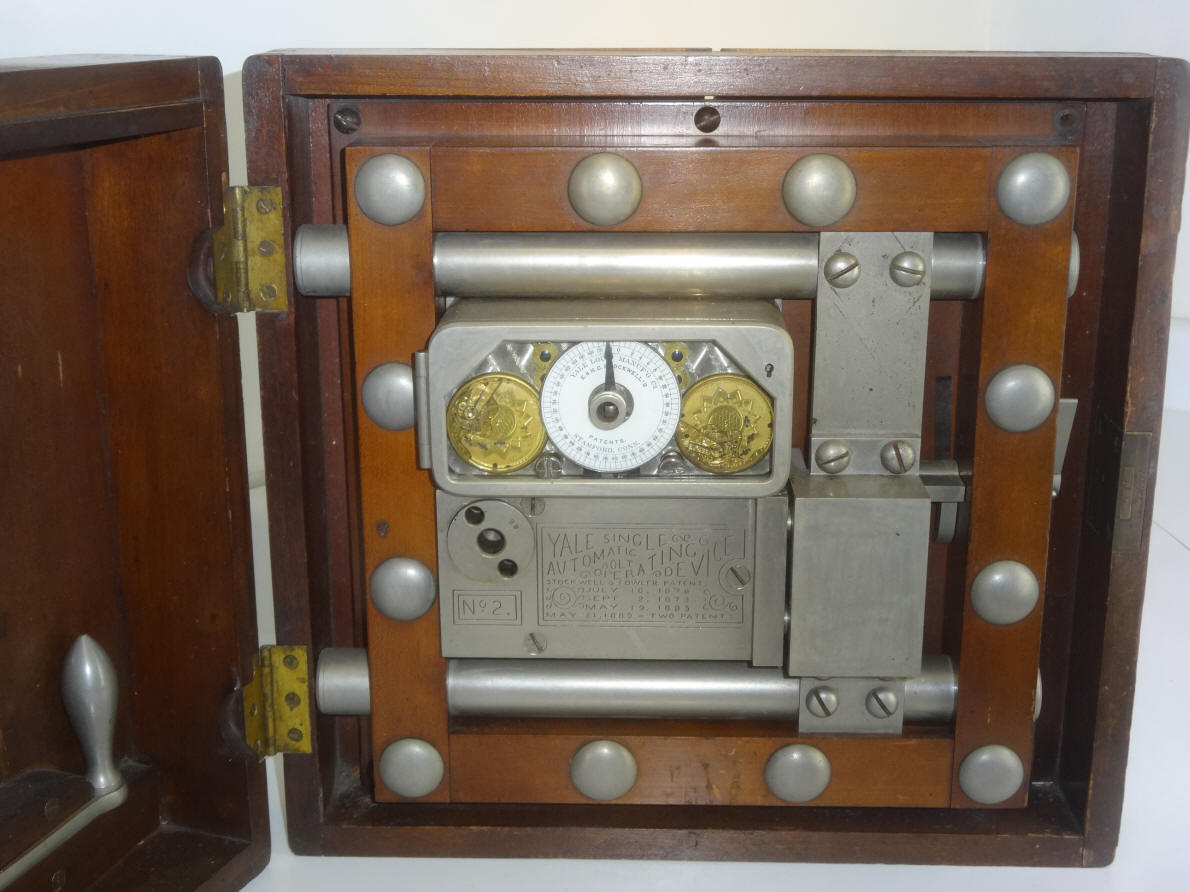
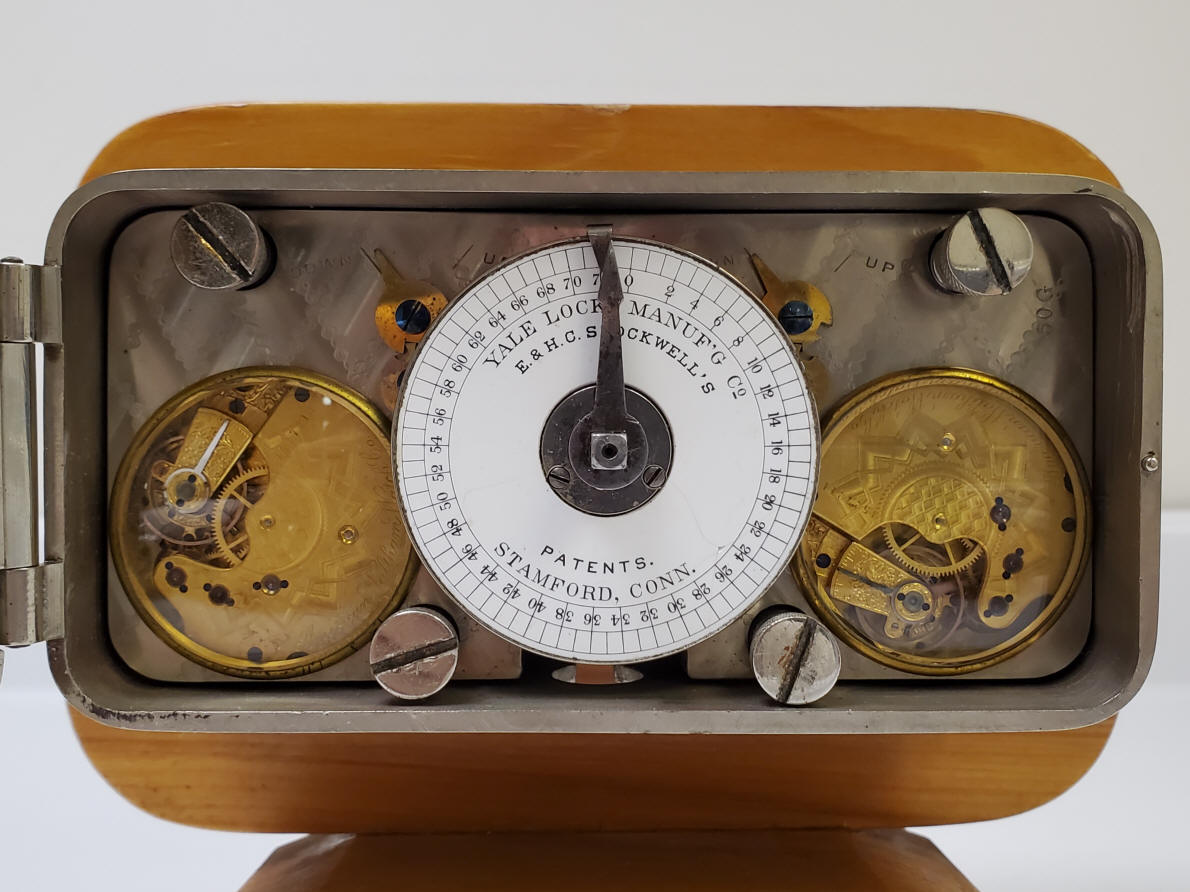
Front elevation of the Type G with door opened.
The first photo shows the rear of the time lock. Note the similarity to that of the Type E where both springs are wound simultaneously and the use of the wiper to trigger the bolt release. The bolt trigger fits within the bottom of the case and is located within the recess behind the wiper. Next a section of the rear dial showing the holes to secure the position of the stop flag. The drilled detents shown on the Type D performs this same function.
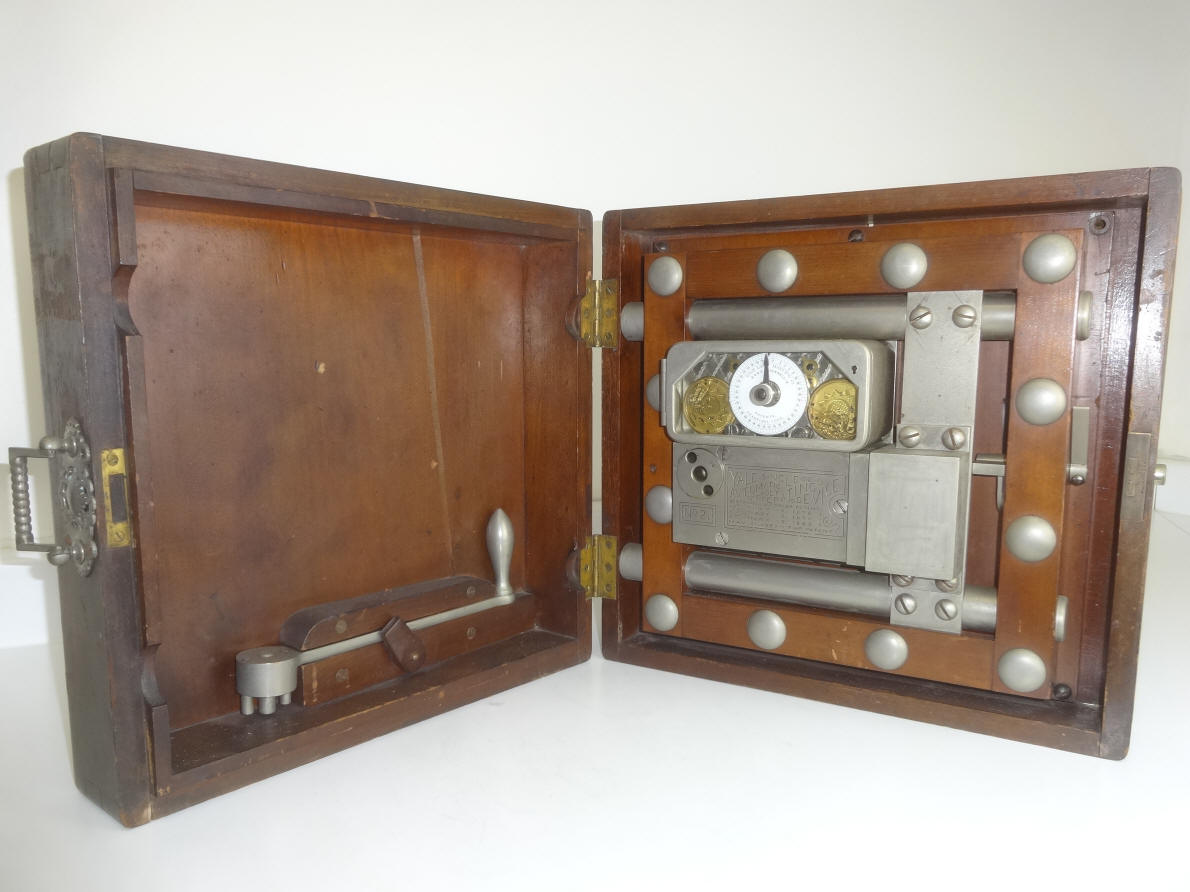
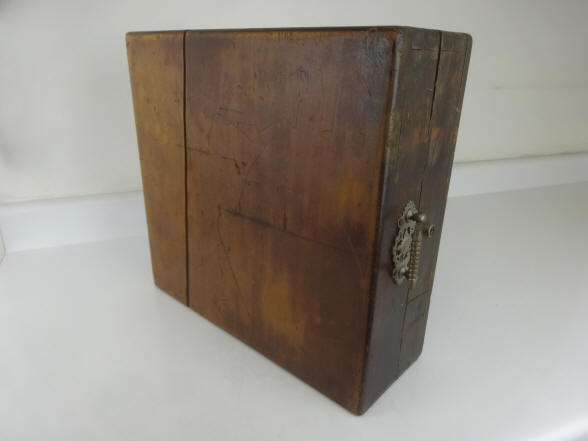
The example of Yale's Type G shown here controls a Yale No. 2 bolt motor, allowing the time lock to be used independently of any combination lock. It is the only known complete example of a Type G to survive. As shown by the heavy wooden case this was a salesman's sample It is believed that Yale mounted many if not all of their samples in similar cases, yet this is the only Yale time lock salesman's case to survive.
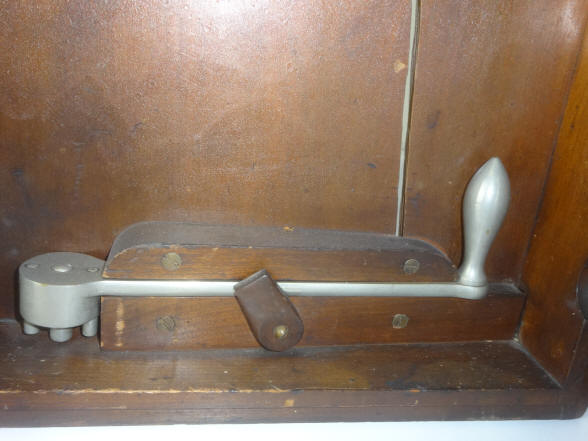
The first photo shows the bolt motor winding handle in the stowed position. Next an exterior shot of the case, of course the case lock is also a Yale.
A. Yale Type G, 1889. The Yale Type G was designed with a release to be used with an automatic bolt motor. The company of E. Howard & Co. and later, after 1902, Seth Thomas supplied nearly all of the movements for Yale time locks (until the 1950's when movements from Switzerland were used). An exception are the Yale Type B through G models which used a modified version of a pocket watch; size #14, model 84 movements by American Waltham Watch Co. A smaller Waltham movement was also later extensively used in Mosler time locks. The movements were designed with anti-magnetic qualities - cutting edge technology for the day. This would be the smallest time lock made by Yale until the introduction of the T221 model in 1920. This model as were all the Type a through G models were not successful, and while twenty-two were ultimately produced, it appears that most if not all were installed into salesman's sample cases and none were actually sold. It is the same as the example illustrated in American Genius, page 248-249. A lone movement is found in the Harry Miller Collection, see below. 5 1/2"w x 2 3/4"h x 2 1/2"d Case #22, movement plate #12G, consecutive movements #4527238 and #4527239. file 199 Notice that this and the example below both have consecutive numbered movements and are numerically close to each other. None of the other Yale locks in the B through EE series which all use the same Waltham model of watch movement have consecutive numbers. One has two out of three movements with consecutive numbering but all others do not. This implies to this author that the Type G was probably never commercially sold. It is likely that when produced all of the locks in the B through EE series made from 1889-1892 had consecutively numbered movements. The fact that none currently do indicates the rapid change out of these movements during this brief span of time and over a small number of movements fabricated confirming the problems that Yale had with these watch movements as applied in this series of locks; leading to their commercial failure and resulting in limited production.
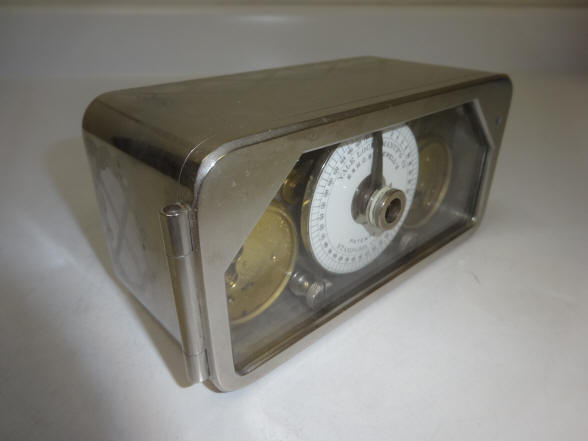
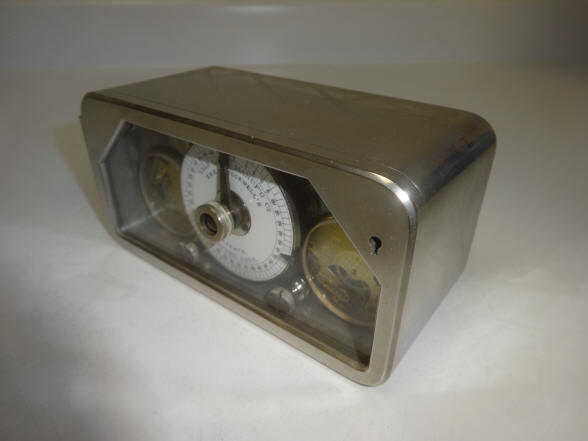
B. Yale Type G, 1889. This Yale Type G, identical to the example above. Other than an incomplete example in the Harry Miller collection, these are the only two complete example of the Type G known. 5 1/2"w x 2 3/4"h x 2 1/2"d Case #13, movement plate #6G, consecutive movements #4527211 and #4527212. Notice that this and the example above both have consecutive numbered movements and are numerically close to each other. file 344 An interesting aside is the fact that both Seth Thomas and E. Howard were companies that made a full line of clocks and watches. From large tower clocks (for public buildings) to domestic clocks to watches as well as movements for time locks. Click here to see a medium sized Seth Thomas and Howard tower clock. A Yale Type G movement in the Harry Miller Collection, Nicholasville, KY. Other than the two examples shown here, this the only other known example of this model.
|


 A
A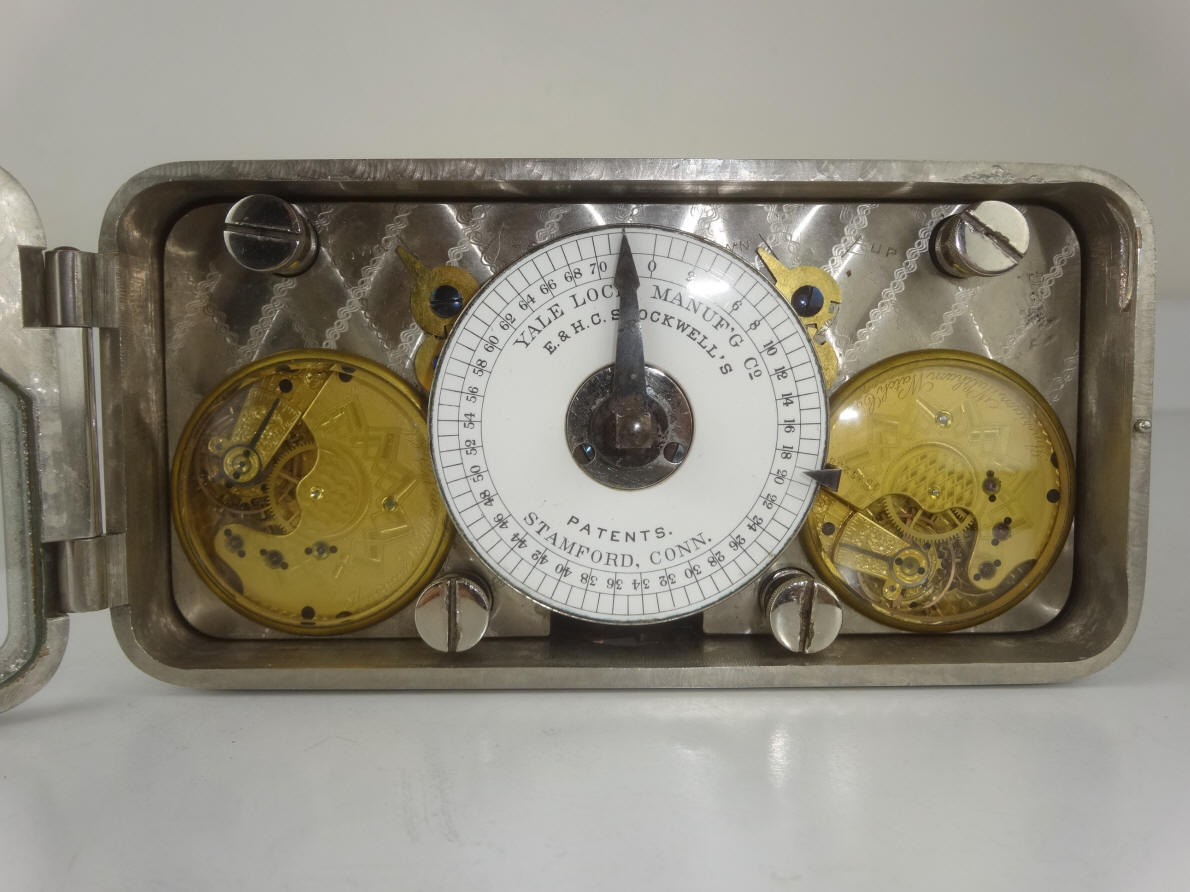
 B
B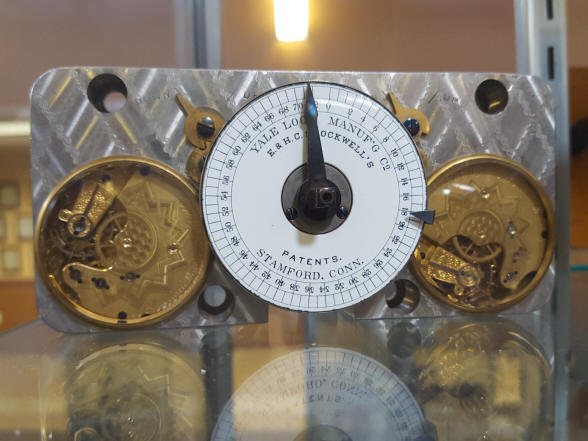
(1) American Genius - Nineteenth Century Bank Locks and Time Locks, John and David Erroll, pp. 248-249


